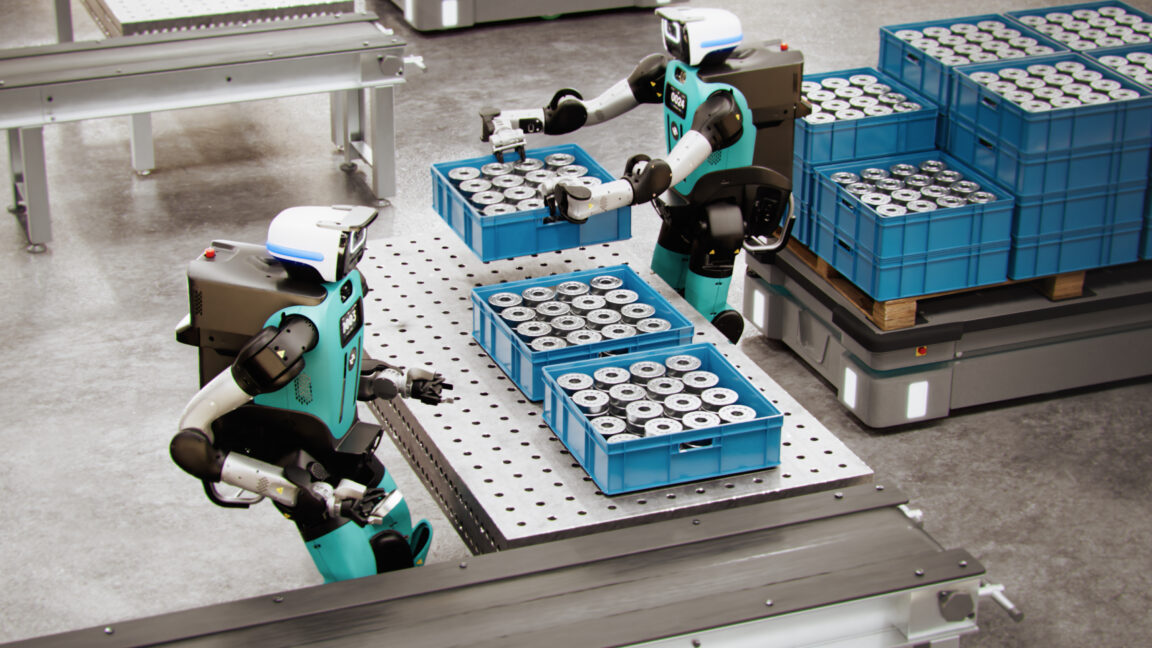
Agility Robotics began trading on the Nasdaq on November 5 under the ticker AGLT, becoming the first dedicated humanoid robotics company to list publicly in the United States. The Salem, Oregon-based company went public through a merger with a special purpose acquisition company, or SPAC, raising $465 million in new capital from retail investors and private funding, according to Bloomberg and TechCrunch.
The listing marks a milestone for the physical AI boom, giving public-market investors their first direct bet on a pure-play humanoid robot maker. Agility's Digit robots already work in warehouses and factories for customers including GXO, Schaeffler, Toyota Motor Manufacturing Canada and Mercado Libre — real deployments that its privately held rivals, such as Figure, Tesla and Boston Dynamics, have yet to match at the same scale.
Agility Robotics IPO and Digit 5 economics
In an S-4 filing with the US Securities and Exchange Commission dated September 4, Agility laid out rare illustrative unit economics for humanoid robots, a level of disclosure its private competitors have avoided. CFO Michael Beer said the subscription model lets customers replace $200,000 in annual labor costs with $100,000 in annual robot costs, while buying a Digit outright could replace $1.1 million in labor costs with about $400,000 over five years.
Agility also estimated each Digit 5 costs about $150,000 in bill-of-materials terms to build, with roughly $15,000 in annual software and maintenance costs per robot. The company reported $174,000 in revenue for the first six months of 2026 — mostly from related parties — against a $362 million loss in the same period, a gap that puts pressure on it to convert its new capital into deployments.
The next-generation Digit 5, with swappable hands and a Nyobolt fast-charging battery, is set to reach customers in 2027, with prototypes expected at CES 2027. CEO Peggy Johnson said Agility has $300 million in planned contracts from 30 customers, though the deals depend on hitting undisclosed targets for throughput, uptime and placement accuracy.