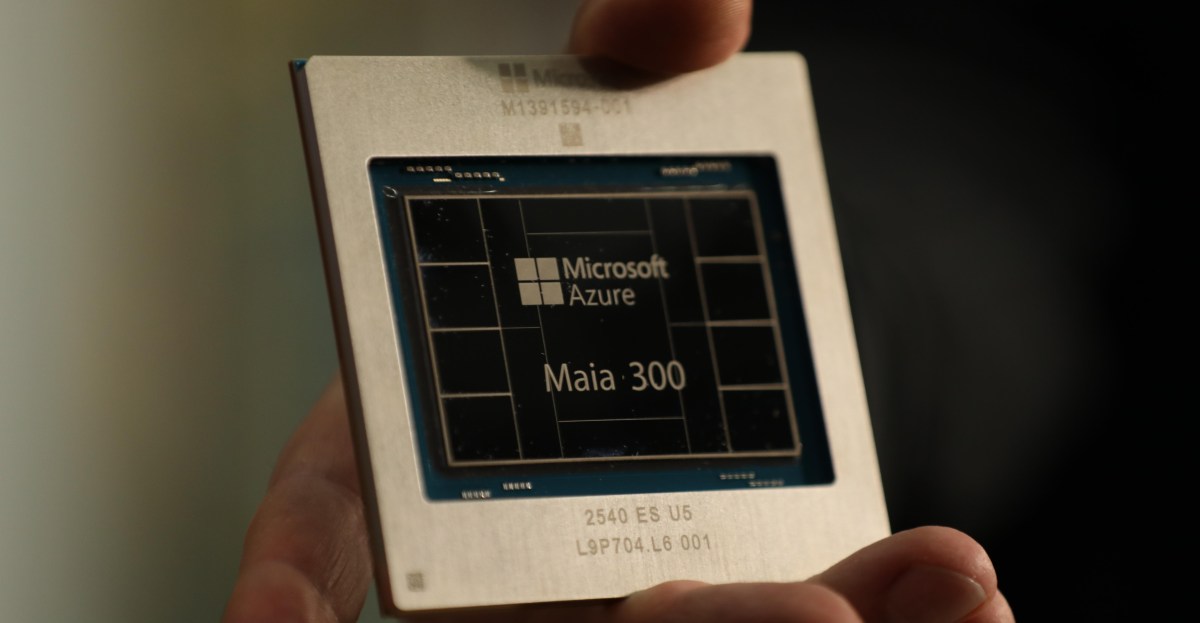
Microsoft has announced the Maia 300, its third-generation in-house AI chip, positioned as the "primary AI inference system" for Microsoft products and services. CEO Satya Nadella called it "our biggest bet yet on our own silicon," according to The Decoder. Reuters reports that each Maia 300 rack will hold 96 chips and draw roughly 167 kW of power, with Microsoft planning multi-gigawatt deployments starting next year.
Production rollout is targeted for 2027, and the company expects Maia 300 to deliver 40 percent more tokens per megawatt than leading GPU-based systems, according to Scott Guthrie, executive vice president of Microsoft's cloud group. In a full 96-accelerator rack, Microsoft claims up to seven times the rack-scale token throughput of the previous Maia 200.
Microsoft Maia 300 specs
Maia 300 is built on TSMC's N2P process node using a new chiplet architecture that separates compute, memory controller, and I/O functions. Microsoft's Azure hardware and infrastructure team said this "increases the silicon area dedicated to compute performance and allows each function to use the technology best suited to its role."
Notebookcheck reports the chip carries 288 GB of HBM4 memory with 18 TB/s of bandwidth. Microsoft says the design is aimed at the workloads emerging today: long-context reasoning, latency-sensitive conversational experiences, and sustained multi-step agentic tasks.
- Process node: TSMC N2P
- Memory: 288 GB HBM4, per Notebookcheck
- Memory bandwidth: 18 TB/s, per Notebookcheck
- Rack density: 96 chips at roughly 167 kW