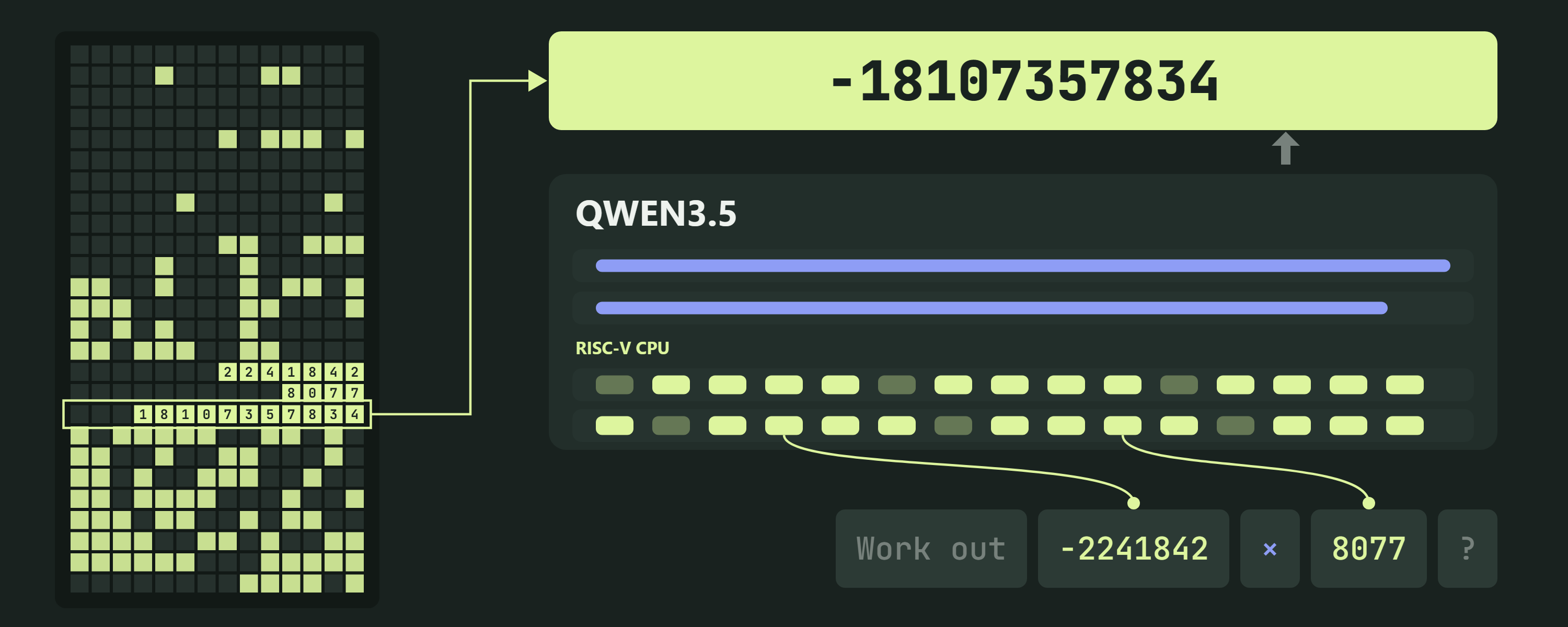
A developer has built Qwenputer, an experimental version of Qwen 3.5 4B with a working 32-bit RISC-V CPU compiled directly into the model's weights. According to the project write-up on divagr.com, the CPU does not run as a plugin, a tool or a sandbox: it executes inside the model's forward passes, using Qwen's own Gated DeltaNet attention layers as RAM.
The project is a striking demonstration of how far model internals can be pushed without extra training. The RISC-V core runs C and MicroPython code, passes the official riscv-tests, and matched qemu across its programs. The developer reports 18 million instructions free-running with no errors, meaning the CPU keeps going on its own outputs without a reference machine correcting it between steps.
How Qwenputer uses Gated DeltaNet as RAM
Qwen3-Next and Qwen 3.5, the model Qwenputer is built on, use Gated DeltaNet (GDN) as the attention mechanism in three out of four attention layers. Each GDN head keeps a state matrix, and a gate value between 0 and 1 decides how much of that state fades on every token. The developer found that by setting the gate to 1, the write strength (beta) to 1, and using one-hot key encoding, every write overwrites exactly one row and every query can retrieve an exact value.
That makes the GDN layers behave as exact, addressable RAM at a much lower cost than using normal attention as RAM, because a GDN head's state stays the same size no matter how long the conversation grows. The write-up credits Schlag, Irie and Schmidhuber (2021) with showing that linear attention with the delta rule works as an associative memory; the new step here is making it exact and addressable inside a production model, reliably enough to run a whole CPU on it.
Qwenputer RISC-V CPU specs and accuracy
The CPU was compiled, not trained: a compiler sets every weight directly by turning circuit steps into transformer components, with attention heads that look up values, feed-forward units that do arithmetic, and DeltaNet heads that hold the RAM. Each instruction becomes a few generated tokens, and those tokens are the CPU's execution trace, so the CPU runs while Qwen generates them.