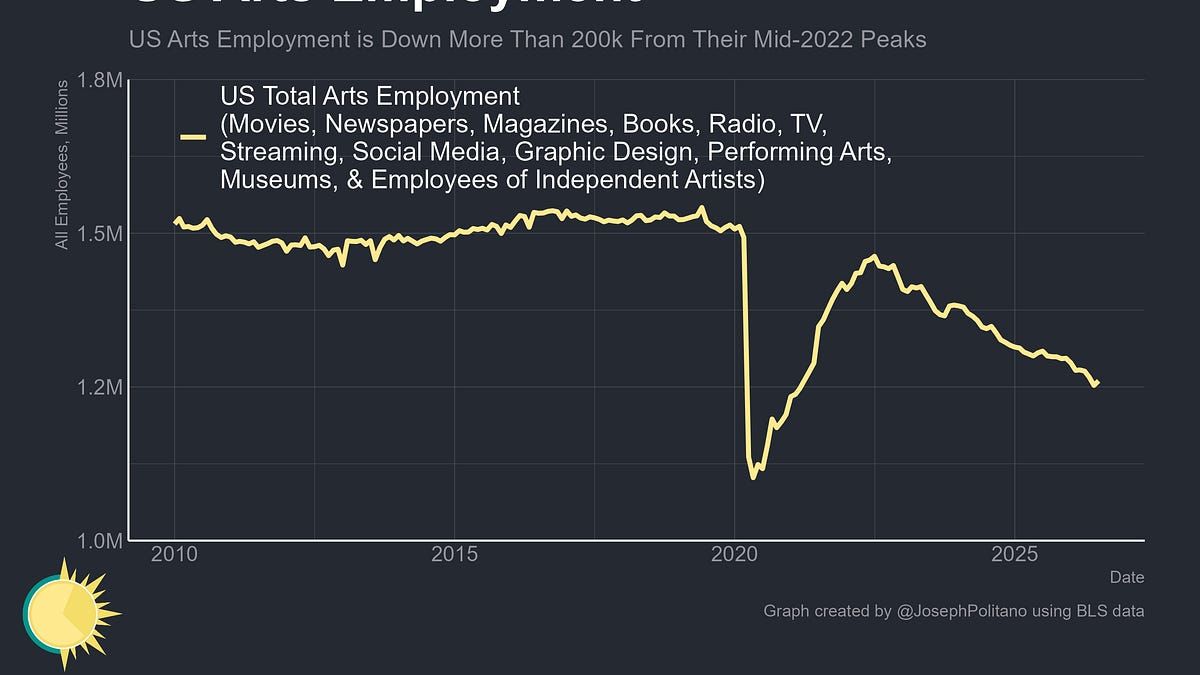
The United States has lost more than 200,000 jobs in media, film and the arts over the past four years, with roughly 50,000 of those disappearing in the last year alone, according to an analysis published by Apricitas Economics. Writer Joseph Politano calls it one of the worst stretches for American media employment in modern history — comparable in intensity and length only to the 2001 and 2008 recessions, but this time without a general recession.
Instead, the losses line up with the rise of artificial intelligence systems that can produce novels, photorealistic images, soundalike music and nearly any other form of digital art at scale and at very low cost. The question Politano raises is blunt: how much of this is AI, and is this the fall of the creative class?
Why the AI jobs connection is hard to prove
Politano is careful: pinning an exact number on AI-driven job losses in the arts is extremely difficult. Media companies are deliberately vague about how they use AI, both to avoid public backlash and, more importantly, to protect the legal basis of their copyrights.
Other forces are also at work. Hollywood consolidation, the offshoring of content production and the shift of audiences from traditional media to social media creators all weigh on the same jobs. That mix makes it impossible to isolate a single cause — but it does not make the timing less striking.
What the 200k media job losses look like
The headline figure is the strongest part of the case. The scale and duration of the decline in creative-industry employment has few parallels outside major economic downturns.
The Apricitas analysis says the clearest evidence of AI's influence lies in the details of where and how these jobs vanished — a picture that is still forming.
- More than 200,000 creative-industry jobs lost in the US over four years