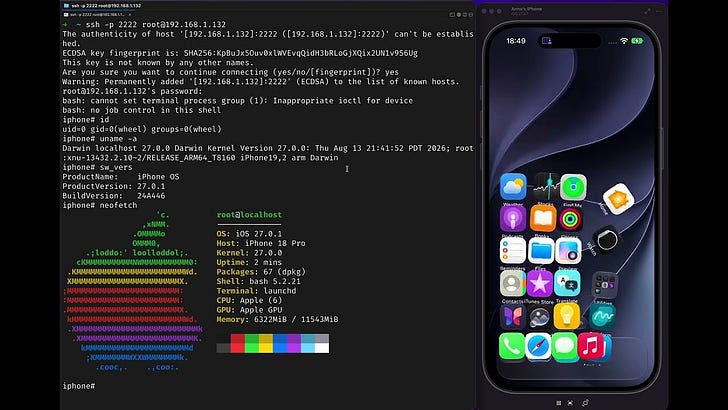
Security outfit Calif says it has done what many researchers only attempt: hack the iPhone. The company announced on its blog that it reached full exploitation of Apple's device, publishing the claim on October 16, 2026 under the blunt headline "Today, we hacked what we'd set out to hack: the iPhone."
The announcement coincides with Hexacon, a security conference held in Paris, where Calif says it revealed a series of demos. Calif states that all the material will be released in due course, without giving a date. The significance is obvious for anyone carrying an iPhone: a working exploit chain against Apple's flagship platform is about as serious as mobile security news gets.
IPhone exploit demos: Signal, iMessage and an APT
Calif's post lists four demos shown at Hexacon. The first is described as a Signal 1-click attack. The second targets iMessage, with Calif noting that a third-party app hardly matters when most iPhone users rely on Apple's messaging service. The third is framed as a challenge to readers: "Can your iPhone do this?" The fourth carries the line "APT stands for Apple Persistent Threat," a play on the term for advanced persistent threat.
The post does not include technical detail, vulnerability identifiers or a timeline for publication. The wording is deliberately teaser-like, and Calif's own material says only that everything will be released in due time and that the demos are what the team revealed in Paris.
What Calif has not shown
There is no public proof yet beyond Calif's own description of its Hexacon demos. The blog offers no affected iOS versions, no CVE numbers, no technical write-up and no statement from Apple. Apple has not confirmed that any of the claimed attacks work against current iPhones.
That leaves the claim firmly in leak or unverified territory, however specific it sounds. Until Calif publishes the demos or independent researchers reproduce the work, readers should treat "iPhone fully hacked" as an unconfirmed assertion rather than a demonstrated fact, and watch for Apple's response.