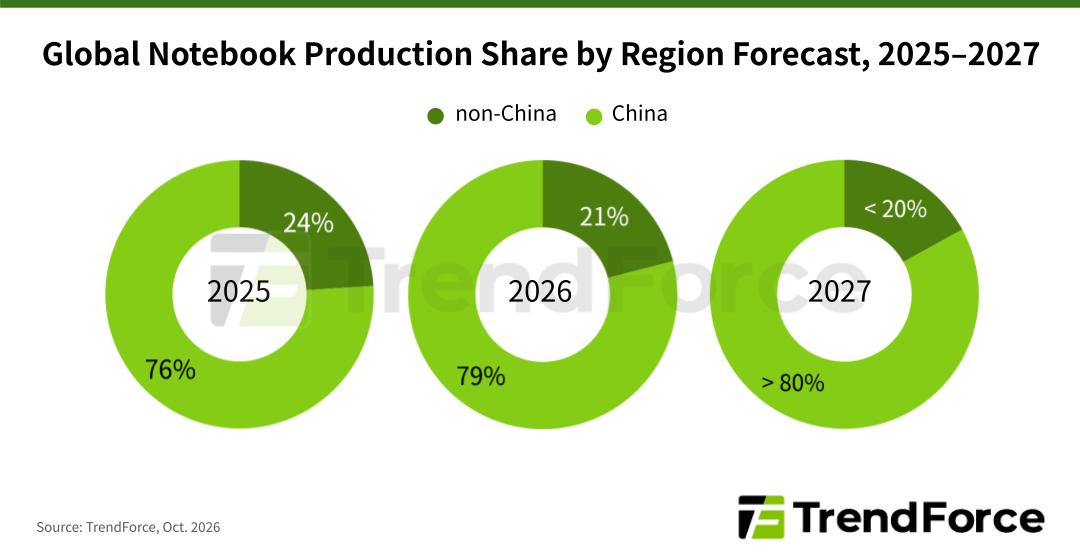
Laptop makers are quietly reversing part of their move away from China. According to new notebook industry research from TrendForce, the share of global notebook production built outside China is expected to fall from around 24% in 2025 to 21% in 2026, and could slip below 20% in 2027.
The reason is cost, not policy. With CPU, DRAM and SSD prices staying high, TrendForce says the extra logistics, component sourcing and supply-chain management costs of newer manufacturing locations now weigh more heavily than the geopolitical risk they were meant to reduce.
Why laptop production is moving back to China
TrendForce frames the shift as a change in what guides manufacturing decisions. If tariff pressure does not intensify further, brands are expected to prioritize production cost, supply-chain completeness and operational efficiency over minimizing policy risk.
That calculation favors China, where component suppliers, assembly capacity and logistics are already concentrated. TrendForce suggests some capacity built elsewhere for risk diversification could be relocated back, though it does not name specific brands or factories.
Component costs now dominate laptop prices
For a mainstream notebook with a suggested retail price of US$900 (roughly 2,610 TND), TrendForce says CPU, DRAM and SSD components made up about 68% of the bill of materials in the third quarter of the year. That leaves brands with little room to absorb further increases.
Memory is a key pressure point: AI server demand keeps absorbing advanced-process capacity, so DRAM supply is likely to stay tight, while PC DRAM faces limited supply growth. NAND Flash constraints could ease in the second half of 2027 as new capacity comes online, and PCBs, MLCCs and PMICs are also under pressure from capacity allocation, raw material costs and geopolitical issues.